

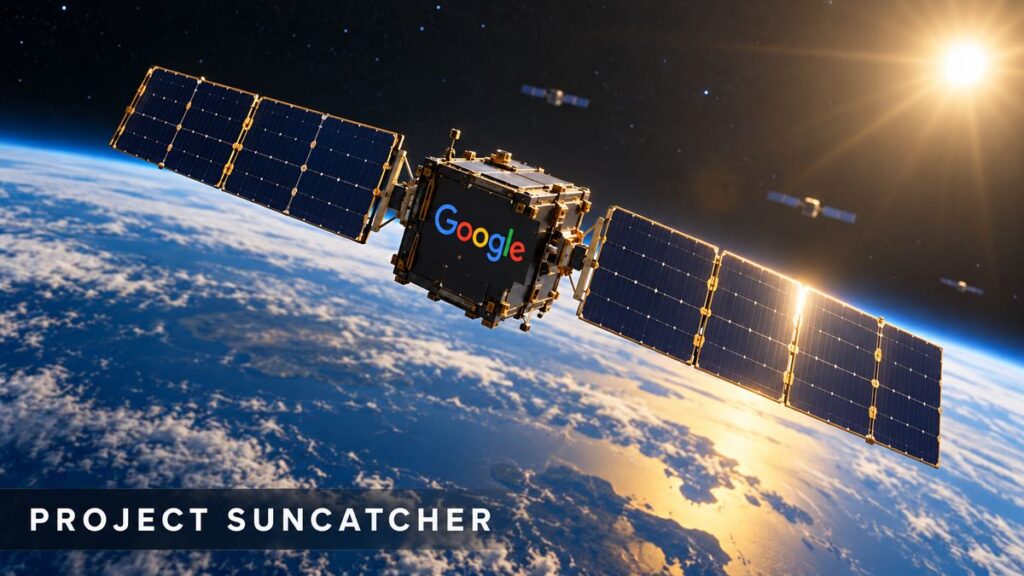
The AI race is moving beyond Earth. Google is now testing whether its AI chips can work in space through Project Suncatcher, an ambitious plan that could eventually turn satellites into small data centers.
Google’s first step is an experimental satellite designed to test its Tensor Processing Units (TPUs) in orbit. The satellite is scheduled to launch aboard SpaceX’s Transporter-18 mission. The test will focus on whether Google’s hardware can survive the extreme conditions of space while handling basic AI workloads.
Why Google Wants Data Centers in Space
The rapid growth of artificial intelligence has created a huge demand for computing power. But building more data centers on Earth comes with major challenges, especially electricity consumption.
Data centers require enormous amounts of power to run and cool their servers. According to the information provided, natural gas supplied more than 40% of electricity used by U.S. data centers in 2024. Solar and wind provided about 24%, while nuclear contributed roughly 20%.
Space could offer a very different energy environment.
Satellites can use solar panels without the atmosphere blocking sunlight. They also do not face the same day-night cycle as solar installations on Earth. Google says satellites in low Earth orbit could potentially generate up to eight times more solar power than comparable systems on the ground.
That makes space an interesting option for the future of AI infrastructure.
What Will Project Suncatcher Test?

The first mission is not a complete space-based data center. It is an engineering experiment designed to collect real-world information.
Google needs to understand how its TPUs handle launch vibrations, radiation and extreme temperatures. Cooling is another major challenge because traditional data centers rely heavily on air and water-based cooling systems.
Google’s Trillium chips have already undergone proton-beam testing designed to simulate radiation exposure. However, an actual orbital mission will provide a much tougher test.
| Challenge | Earth Data Centers | Space-Based Computing |
|---|---|---|
| Power source | Grid, solar, nuclear, gas | Mainly solar |
| Cooling | Air and water systems | Space-specific cooling |
| Environment | Controlled | Radiation and temperature extremes |
| Transportation | Roads and conventional logistics | Rockets and spacecraft |
| Main challenge | Energy and infrastructure | Launch cost and reliability |
Google Is Entering a Bigger AI Infrastructure Race

Project Suncatcher is also part of a wider competition around AI computing infrastructure. Companies are investing heavily in chips, data centers and new ways to increase computing capacity.
SpaceX is expanding its own AI computing infrastructure, while Google is preparing to test its AI hardware in orbit. The two companies are also connected through launch and cloud-computing agreements.
Still, turning the experiment into a profitable business is a completely different challenge. Launch costs, satellite replacement, communication systems and reliable connections between satellites must all become economically practical.
For now, Google Project Suncatcher is an experiment rather than a finished product. But if the technology works, the idea of putting AI computing infrastructure above Earth could become a much bigger part of the technology industry.